
Last week I got on a screen with a CMO candidate who’d helped take a unicorn company public.
Two degrees in a field I’d struggle to spell. A résumé that made mine look like a grocery list. I figured I’d spend the call nodding along.
Ten minutes in, we both knew we needed each other.
Here’s how that happened, and why most calls never get there.
The part of the job nobody sees
Recruiting can be repetitive. It can be lonely. Some weeks it makes you wonder what you’re doing with your life.
And a big part of the job is talking to people who are way smarter than you and make way more money than you.
You have to cut through the ego and the status and actually connect. At the same time, you have to judge, honestly, whether they’re right for the role.
Warm and objective. In the same 30 minutes. That’s the tightrope.
The call
Back to the CMO.
She didn’t brag. She didn’t recite her résumé. She let me ask direct questions, and she answered them clearly, in plain language. No buzzwords.
And she asked me just as many. She wanted to understand the role as badly as I wanted to understand her.
Somewhere in there, the power dynamic disappeared. On paper, she looked impossible to get. In reality, she was ready for her next move.
I needed a polished candidate with a serious track record. She needed a unicorn-stage company where she could put her marketing and analytical chops to work.
Once that was on the table, it was go time.
First drafts are slop
Every week I sit down to write this newsletter. And every week, my first draft is slop.
That’s fine. That’s what first drafts are for. You get the throat-clearing out of your system so you can find what you actually mean.
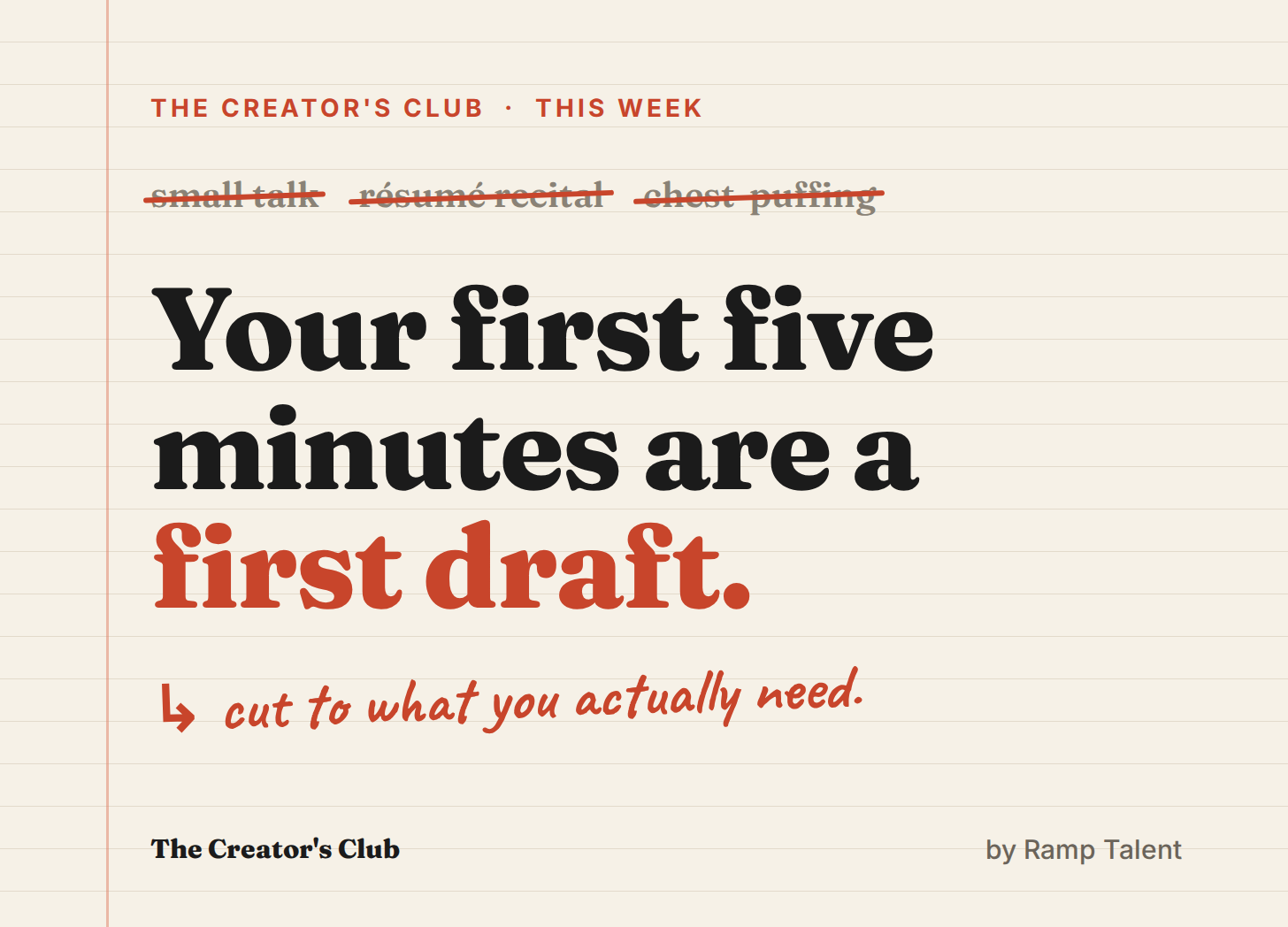
Most conversations start the same way. The first five minutes are a first draft: small talk, résumé recitals, a little chest-puffing. Nobody’s saying what they actually want.
Here’s the difference:
You can edit a draft. You can’t edit a first impression.
The faster you get to intentions (what do you need, what do I need), the faster you both know if there’s something here.
What this means for you
If you’re a candidate:
Skip the résumé recital. They’ve read it. Open with what you’re looking for next and why.
Answer the question they asked. Plain language beats impressive language every time.
Interview them back. The CMO asked me as many questions as I asked her. That’s what made her credible, not her IPO.
If you’re hiring:
Say what you need out loud, early. “Here’s the problem this hire solves” builds more trust than ten minutes about the weather.
Notice who doesn’t need to impress you. Confidence without the performance is a signal worth paying attention to.
Remember you’re being interviewed too. The best candidates are always interviewing you.
Recruiting, like honest sales, is about solving someone’s problem. The hiring manager needs great people. The candidate needs a better job. My job is to get both of them to the truth faster.
Simple. Not easy.
One confession
I’ve tried using AI to brainstorm these issues. (I know.) It comes out sounding like, well, AI. Polished and empty.
So here’s how this one got made: the first draft was mine, and it was messy. Once I knew what I was trying to say, I used AI to help tighten it.
Same rule as a good screen. Get clear on intent first. Then the polish actually helps.
Hiring for a role where the best people are harder to reach than they look (technical, executive, or construction)? Hit reply and I’ll tell you what I’m seeing in the market. And if you’re the one quietly ready for a move, same offer.
If this landed, forward it to the person who still opens every interview with “So, walk me through your résumé.”