
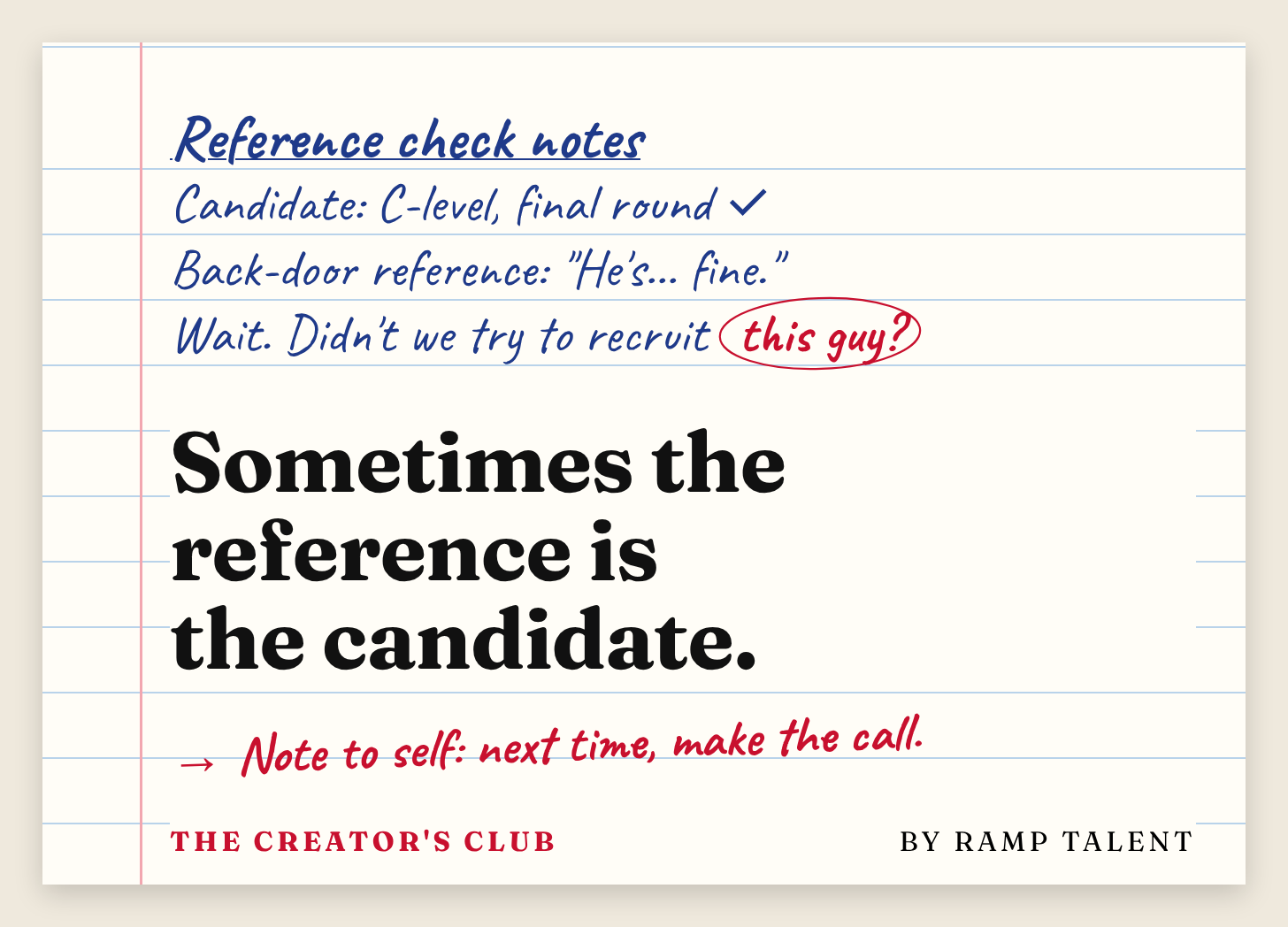
We had a C-level candidate in the home stretch of a search.
Reference checks. And not the friendly ones he handed us.
The back-door ones.
You know the drill. The investor makes a few calls to people the candidate didn’t list. Nobody’s prepped. Nobody’s polished. You get the unfiltered version.
One of those calls came back lukewarm. Not a disaster. Just... meh.
Then I saw who the reference was.
I’d already called him
A month earlier, I’d reached out to that same person about this same search.
Back then it was an SVP role. Confidentiality being what it is, let’s call it SVP of Coffee Cups.
He was gracious about it. Said he was happy where he was. No thanks.
By the time his name came back as a reference, the role had grown into a C-level seat. Chief of Coffee Cups.
When I saw his name, my gut said: that’s the candidate.
But he’d just been on the phone with the client’s investor. Calling him again to recruit him felt awkward.
So I didn’t.
The plot twist
A couple of months later, I learned the client is in late-stage talks with... him.
For Chief of Coffee Cups.
The reference. The guy who’d said no. The one I talked myself out of calling back.
I knew it the second I heard. I should have made that call. I should have trusted my gut.
(Our candidate is still in the mix, and I genuinely hope this works out well for everyone.)
Which made me realize
You never know where your next hire is coming from.
I’ve stayed in touch with references for years, hoping a few would turn into candidates or clients. One reference from 2018, became a candidate for a VP of Product in 2021. This has happened a couple of times with other roles
But I never pictured a reference ending up in the exact job they were giving a reference for.
Here’s the thing about a “no.” It’s a no to that role, at that moment. Change the title, the scope, or the timing, and you might be talking to a different person.
On a reference call, two people are being evaluated. Only one of them knows it.
If you’re hiring
On reference calls, pay attention to who’s talking. Not just what they say about the candidate. How they think. How they talk about the work. Whether you’d want them on your team.
Your best lead might be the person answering your questions.
And if someone passes on your role, call back when the role changes. “SVP” and “Chief” are two different conversations.
If you’re the candidate (or the reference)
When someone calls you for a reference, you’re on stage too. The person on the other end might be hiring. Or know someone who is.
Be thoughtful. Be generous. Be someone they’d want to call back.
And when a recruiter reaches out and the timing’s wrong, say no the way he did: kindly. Doors you close politely have a way of reopening.
Full circle
Be good to whoever’s on the other end of the phone. Recruiter, reference, candidate, investor.
In this business, everyone comes back around.
Sometimes in the same search.
If you passed on a role and wondered whether it’s changed, or you’re running a search and the shortlist feels thin, hit reply. And if I’ve ever called you and you said no thanks: I’ll probably call again. Now you know why.