
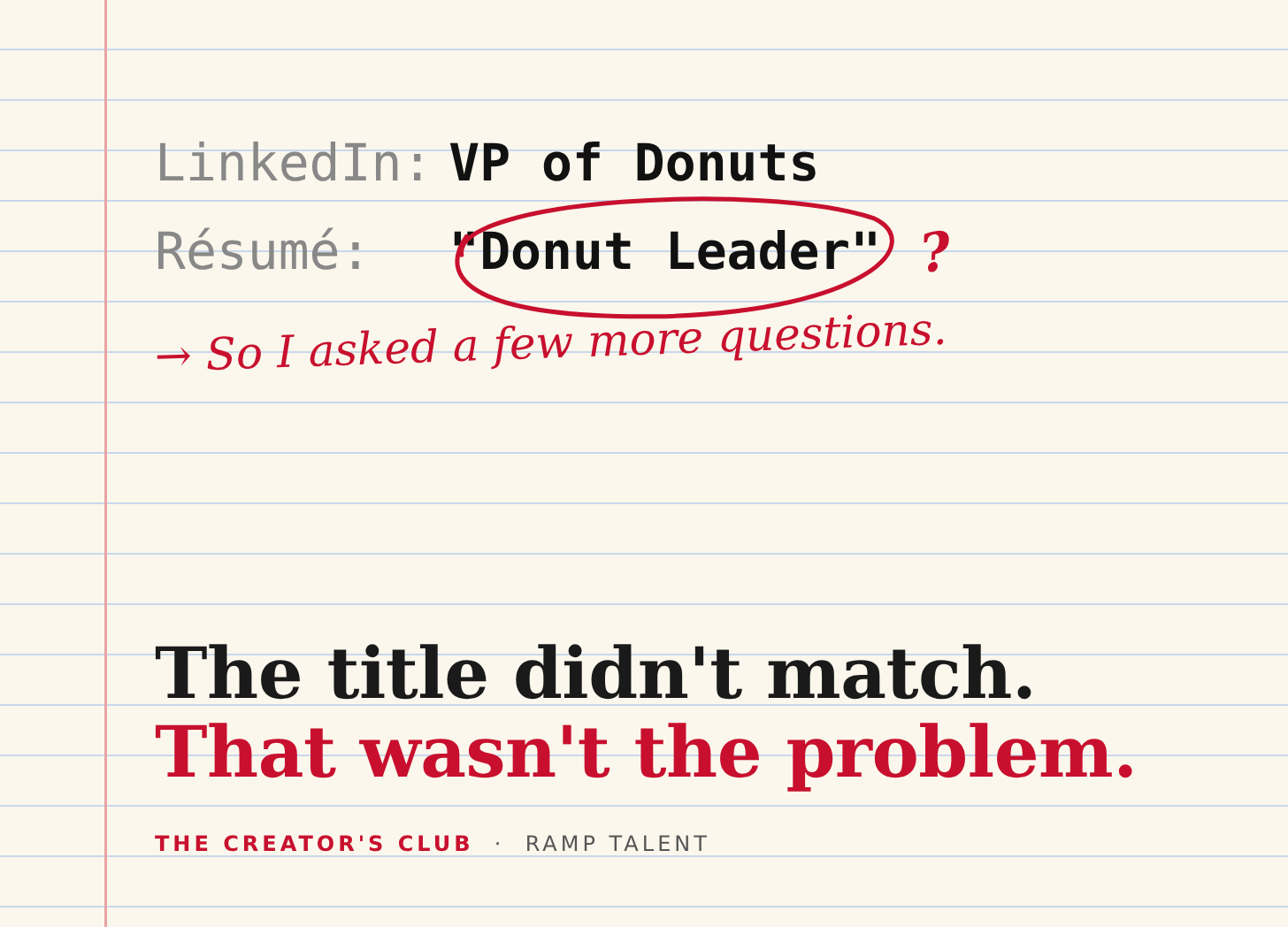
Her LinkedIn said VP. Her résumé said “Donut Leader.”
That gap is where a great interview started to come apart.
The role was VP of Donuts. (Not the real title. Confidentiality. Also, I was hungry.)
On paper, she was strong. She’d helped scale revenue from $500M to over $1B at a company you’d recognize.
In the interview, she was crisp. I asked how she built pipeline, and she had an answer. I asked how she measured marketing past the first click, and she had an answer.
Almost too crisp. Every answer sounded finished. But I couldn’t argue with any of them.
Then her résumé came in.
No VP. No Director. Just “Donut Leader” and “Donut Executive.” Words that could mean anything.
So I went back with more questions. Some about her titles. Some about the one thing this role actually needed: real experience marketing into healthcare.
Healthcare is hard to fake. Long buying cycles. Compliance reviews on every campaign. Buyers who don’t care about your click-through rate.
This time the answers didn’t come. The polish was gone, and there wasn’t much underneath.
We passed.
The title wasn’t the problem
Mismatched titles aren’t automatically a red flag.
Titles are cheap. Every company hands them out differently. A VP at a 30-person startup might manage two people. A Director at Amazon might manage 200.
Plenty of people put the recognizable title on LinkedIn because nobody outside their company knows what “Donut Leader” means. And at startups, people do far more than their title says. I’ve talked to founders who run the board meeting in the morning and take support calls in the afternoon.
So the mismatch didn’t sink her. It got me to ask a second round of questions. Her answers to those sank her.
A title mismatch isn’t a red flag. It’s a question. The red flag is when the answer doesn’t hold up.
If you’re the candidate
Your title is the easiest thing on your résumé to check. Anyone can pull up your LinkedIn in ten seconds. Make sure both tell the same story.
If your official title is strange, don’t swap it out. Translate it:
Donut Leader (VP-level, reported to the CEO, owned a $40M P&L)
Now nobody has to guess, and you can spend the rest of the space on what you actually did.
If it comes up in an interview, have one sentence ready: “My official title was X, but I ran Y and reported to Z.” Done.
A thorough process will find the gap. You want to be the one who explains it, not the one who gets asked.
If you’re the hiring manager
Don’t toss a résumé because the titles don’t line up. You’ll lose good people from companies with weird naming conventions.
Use it as a way in. Ask:
What was your official title, and what did you actually own?
Who did you report to, and who reported to you?
Someone who did the work answers fast and gets specific. Someone stretching it gets vague.
And when every answer sounds rehearsed, ask the question only someone who did the job could answer. For us, that was healthcare. That’s where you find out.
Not sure your résumé and LinkedIn tell the same story? Hit reply and send me both. I’ll tell you what a hiring manager notices in the first 30 seconds.