
A strong candidate was cruising through a panel interview.
Then someone asked how he handles underperformers, and he went for the laugh.
Some context. We’re running a search for a Director of Bananas. (Not the real title. I’ve changed enough details here that I’m not sure I’d recognize this story myself.)
The candidate pool is small, and this guy was near the top of it. Smart, experienced, easy to talk to.
The panel was on video, five interviewers in five little boxes. One of them asked: “How do you handle someone on your team who isn’t pulling their weight?”
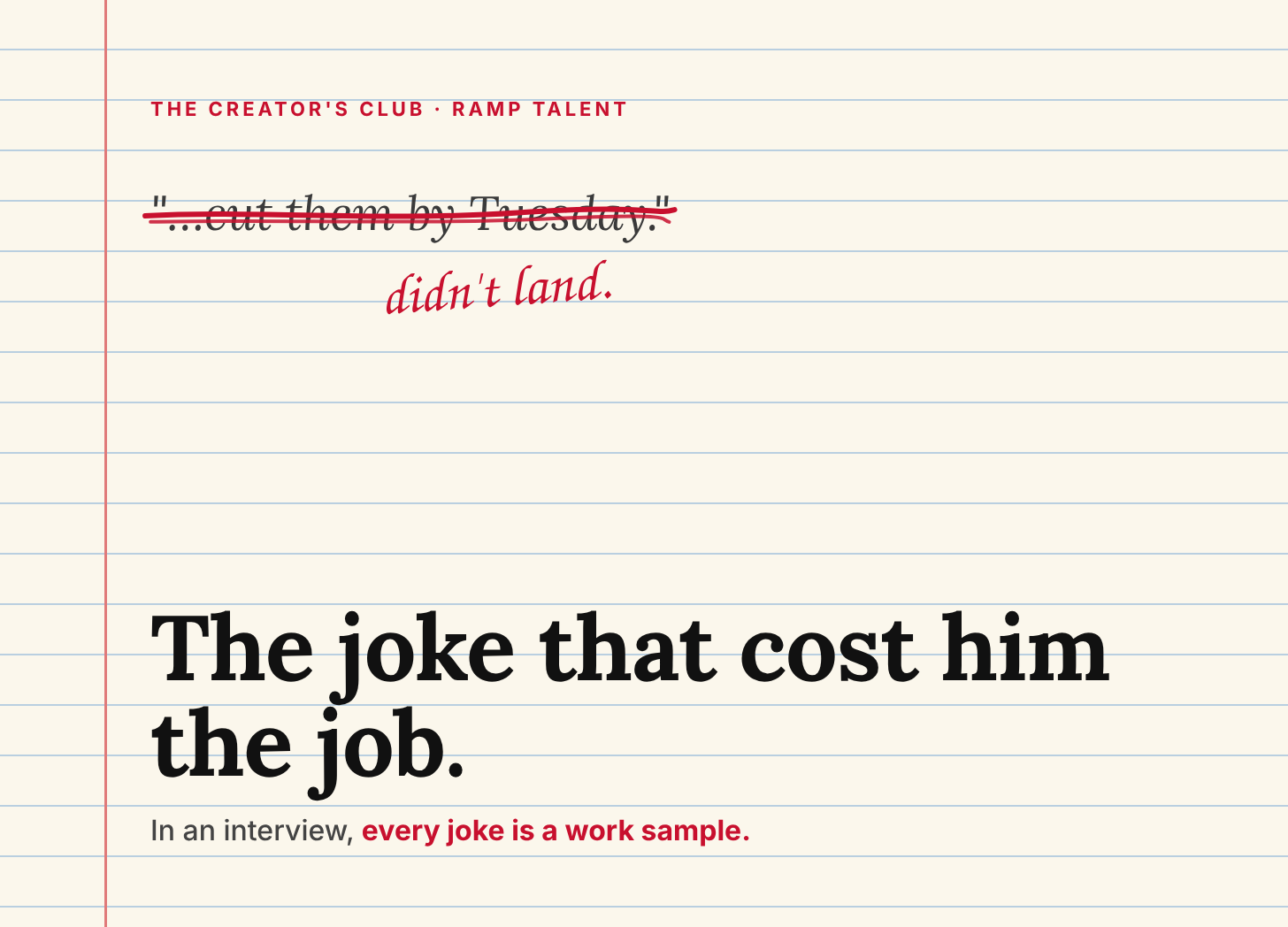
He grinned and said, “Same way I handle my fantasy football team. Cut them by Tuesday.”
Nobody laughed. One interviewer looked down and wrote something.
I wasn’t on the call. But I know this kind of candidate well, and I know what he was going for. It was a throwaway line meant to show he’s decisive, then he’d get to the real answer. And his real answer was good: clear expectations, coaching, documented check-ins.
Nobody remembered the real answer. They remembered “cut them by Tuesday.”
It’s going to be hard to come back from that.
Your reputation doesn’t walk in with you
Here’s something we see over and over with strong candidates.
They have a style, and it works. At their current company, people know them. They know the guy joking about cutting people by Tuesday has spent months coaching a struggling teammate. The joke lands because the trust came first.
In an interview, nobody knows you. There’s no history behind the punchline.
So a joke from a stranger gets taken literally. Especially a joke about getting rid of people. And especially from someone being hired to lead people.
At work, a joke is a joke. In an interview, every joke is a work sample.
The panel wasn’t asking “Is this funny?” They were asking “Is this how he’d lead?”
If you’re the candidate
I love a candidate who can make me laugh. Getting a whole panel of strangers to laugh is even harder. Very few people pull it off in a first meeting. On video it’s even harder, because you can’t read the room when the room is five tiny boxes.
Humor is a skill. If you’re going to use it, treat it like one:
Warm up the room first. Earn some trust before you try anything edgy.
Make yourself the punchline. Self-deprecating humor is low risk. Humor at the expense of the people you’d be managing is a coin flip at best.
Never open a serious answer with a joke. If they ask how you handle people, the first thing out of your mouth is your answer.
Test it out loud. Run your stories past your spouse, a friend, a neighbor. Your dog will laugh at anything, so find someone who won’t. Ask them: “How could this be taken the wrong way?”
No tester? Use AI. Paste in your story and ask how a skeptical interviewer might hear it. Then actually rehearse.
It feels like extra work. It’s a lot less work than starting a new search.
If you’re the hiring manager
The panel made a fair call based on what they heard. But one off-key moment from an otherwise strong candidate deserves one follow-up question in the room:
“Say more about that. What does that actually look like on your team?”
Thirty seconds. Either he walks it back with real substance, or he doubles down and confirms your concern. Both answers tell you more than a note in the margin and a “no” in the debrief.
The bottom line
Your style might be your best asset. But it isn’t introduced yet.
Earn the room first. Then go for the laugh.
Got a story you plan to use in an interview, funny or not? Hit reply and test it on me. I’ll tell you honestly how it would land.